
This article will inform you of the major types of rubber watch straps to help you decide what’s best for you.
FKM rubber, also known as fluoroelastomer or Viton®, offers superior performance compared to natural rubber and polyurethane in several key areas. It excels in high-temperature environments, chemical resistance, and durability, making it a preferred choice for demanding applications. However, it’s also generally more expensive than the other two.
According to Helvetus Straps, “Natural rubber has a slightly softer, more organic feel on the wrist, but it’s less stable long-term under UV, sweat, or oils compared to FKM. Some customers still prefer it for the texture and comfort, so we keep both options in the collection.
Polyurethane rubber has its uses in other industries, but for luxury watch straps, it doesn’t strike the right balance of performance and comfort, so we don’t use it.”
Rolex uses FKM rubber for its rubber watch straps; however, Rolex-owned Tudor uses HNBR rubber, which is a hydrogenated version of NBR, a common synthetic rubber.
Below is a comparison of the three primary types of rubber straps.
FKM rubber (Fluoroelastomer/Viton®)
High Temperature Resistance: FKM can withstand significantly higher temperatures than both natural rubber and polyurethane, making it suitable for applications where heat is a major factor.
Chemical Resistance: FKM is highly resistant to a wide range of chemicals, including oils, fuels, acids, and other aggressive fluids.
Durability: FKM offers excellent wear resistance and a low compression set, meaning it maintains its shape well under pressure.
Cost: FKM is generally more expensive than natural rubber and polyurethane due to its superior properties and the complexity of its manufacturing.
Natural rubber
Lower Temperature Range: Natural rubber performs well in lower temperature ranges but degrades more quickly at higher temperatures.
Limited Chemical Resistance: Natural rubber is susceptible to degradation from chemicals, oils, and UV light.
Cost: Natural rubber is a relatively inexpensive material.
Polyurethane rubber
Good Abrasion Resistance: Polyurethane excels in applications requiring high abrasion resistance and durability.
Flexibility: Polyurethane offers good flexibility, but may not be as flexible as natural rubber.
Lower Temperature Resistance: Polyurethane has limited temperature resistance compared to FKM.
Limited Chemical Resistance: Polyurethane has limitations in chemical resistance compared to FKM.
Cost: Polyurethane is generally less expensive than FKM.
HNBR rubber (Hydrogenated Nitrile Butadiene Rubber)
Enhanced Thermal Stability: HNBR can withstand higher temperatures than NBR, with some grades capable of handling temperatures up to 150°C (302°F) or more.
Superior Chemical and Oil Resistance: The hydrogenation process significantly improves its resistance to a broad range of oils, fuels, chemicals, steam, and oxidizing agents.
High Mechanical Strength: HNBR exhibits excellent tensile and tear strength, as well as outstanding abrasion and wear resistance, ensuring durability in harsh conditions.
Improved Ozone Resistance: The reduced number of double bonds also makes HNBR less susceptible to degradation from ozone exposure. <
Low Compression Set: HNBR retains its shape and elasticity under pressure and heat for extended periods, a crucial property for sealing applications.
Cost: a high-performance synthetic rubber that is significantly more expensive than standard Nitrile (NBR) rubber due to its advanced properties. While its price is relatively high, it’s still generally more cost-effective than specialty elastomers like Viton (FKM) for many high-demand applications.
Final Thoughts
If your application requires resistance to high temperatures and harsh chemicals, FKM is the best choice, even though it comes at a higher cost.
If cost is a primary concern and the application doesn’t involve extreme temperatures or harsh chemicals, natural rubber can be a viable option.
The most cost-effective material with good abrasion resistance and flexibility is polyurethane rubber; however, it has temperature and chemical limitations, and does not feel anywhere near as pliable and luxurious as FKM or natural rubber.
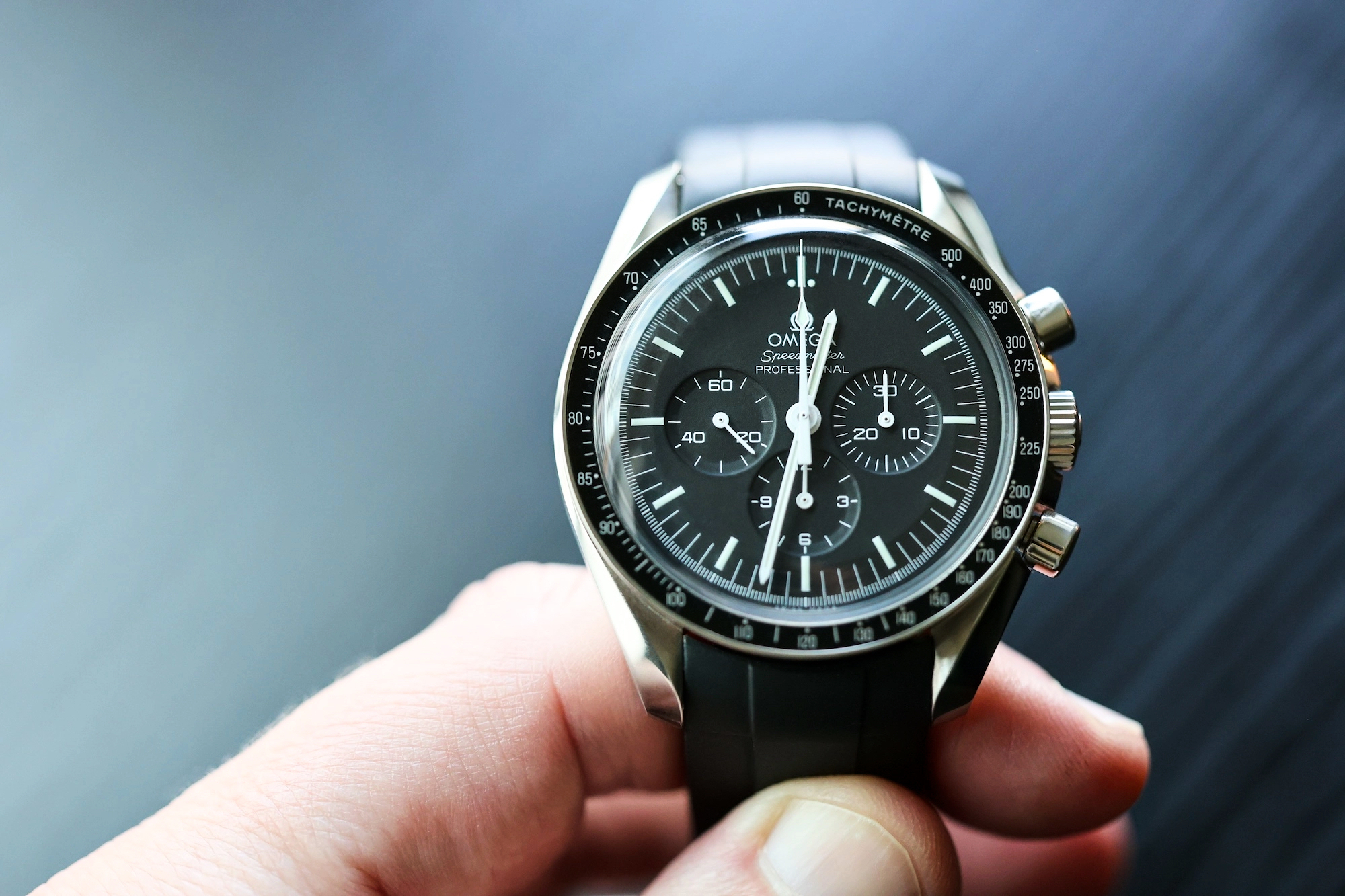
We highly recommend FKM or natural rubber straps, preferably custom molded to your specific case, as shown with the Omega Speedmaster Professional Moonwatch in this article.
Omega Speedmaster Moonwatch Professional pictured in black FKM rubber by Perpetual Straps.
