
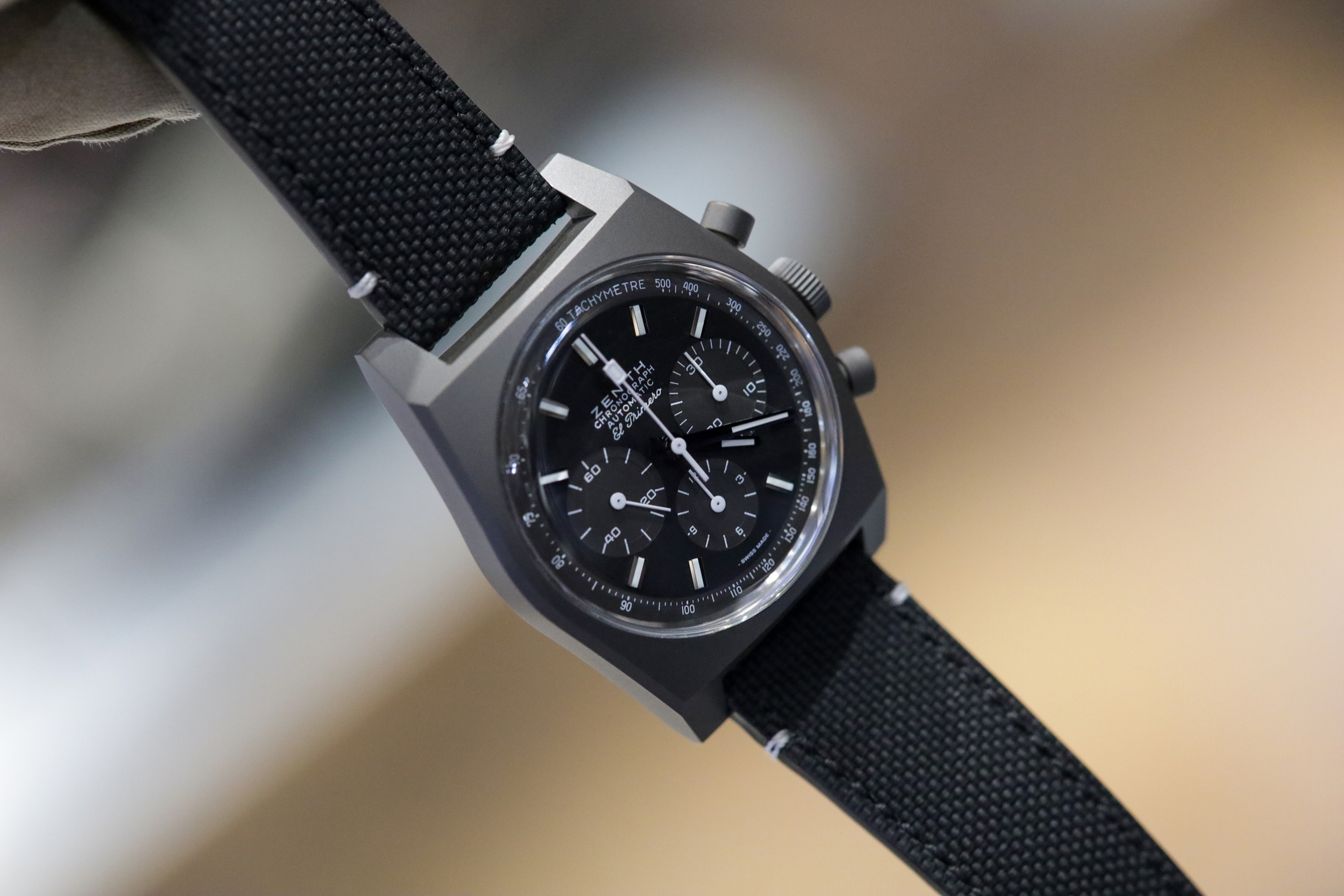
Zenith watches are incredible manufacture quality timekeepers, designed and produced in Le Locle, Switzerland.
Founded in 1865 by Georges Favre-Jacot, Zenith remains in its original location in the Neuchâtel mountains, and is recognized as the first fully integrated watch manufacture.
With a storied history, and a mixture or modern and vintage-inspired timepieces, including the company’s famous El Primero 5Hz technology, and a highly advanced 15Hz technology — that’s at the forefront of chronometry — this is a watchmaker that deserves more credit, and business, than it gets.
The brand, that historically provided chronograph movements to Rolex, should easily be right up there with Omega, Rolex, TAG Heuer, Jaeger-LeCoultre and other leading mainstream watchmakers. But it’s not. Morgan Stanley’s most recent Swiss Watchmaking report, does not even place Zenith in the top 20.
And the reason could be as simple as the fact that LVMH positions TAG Heuer below Zenith, and Hublot above, meaning that constraints get put on the smallest brand, that’s proverbially stuck in the middle.
Even with recent successes in the Chronomaster Sport collection, and significant price increases, Zenith still has not broken free of the reins of its parent company Louis Vuitton Moet Hennessey (LVMH).
Speculation has been rampant in recent weeks that Zenith may be for sale, because the parent company has perhaps finally decided to sell off this asset, that they’ve been unable to grow under the group umbrella.
One detail that makes this speculation more plausible, is that LVMH acquired a minority ownership stake in movement manufature La Joux-Perret in November 2025, which suggests that La Joux-Perret could be utilized to pick up any production void, left by Zenith, if sold. It’s unclear how many movements TAG Heuer and Hublot (and other LVMH group watch brands) source from the Zenith manufacture, but if it’s a significant amount, La Joux-Perret has significant production capacity, making the acquisition of a minority stake by LVMH, appear to be a strategic, rather than an opportunistic investment.
Final Thoughts
As a stand alone brand, Zenith makes a lot of sense, especially if they can get prices in line with reality, instead of needing to offer massive discounts, on exaggerated markups, in order to sell watches. Being positioned above Omega, and closely to Rolex, in my opinion, is a mistake. Zenith is awesome, but price-wise it should likely be positioned below Rolex, and closer to, if not below Omega.
A lower-priced strategy could potentially generate more sales at Zenith, even in spite of the trend at most Swiss watch brands of raising prices as the volume of units turning over continues to decline.
Pricing arguments aside, Zenith could be formidable as an independent. If LVMH is truly willing to sell it, a well assembled independent management team, that can potentially figure out how to grow the iconic watch brand, would be a better outcome than to continually lose millions per year (this is speculative, because Zenith sales numbers are not public).
Bottom line, is that the group mentality, that currently permeates Zenith, is suffocating it. If LVMH sells this desirable asset, it will finally have a chance to blossom, and LVMH can reinvest that cash in fortifying other assets, such as TAG Heuer. Some watch brands have such cachet, and are so inherently strong, they were simply never meant to be joined with other competing interests.
